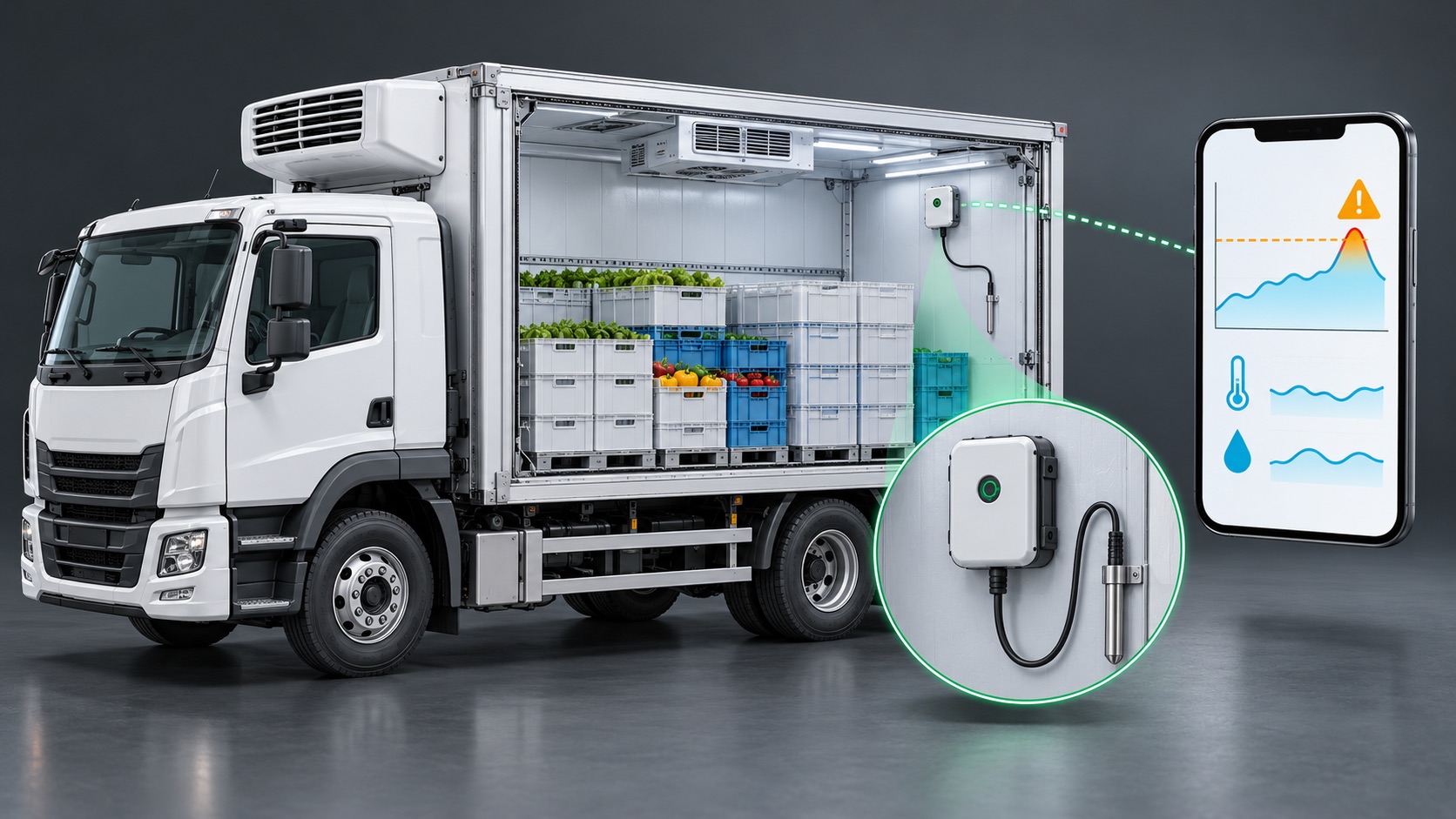
When a refrigerated truck develops a temperature problem, operators need more than the current reading. They need to know when the deviation began, how long it lasted and whether someone has acted on it.
Cold-chain monitoring therefore involves more than choosing a sensor. A complete design connects measurement, recording, transmission and alarm handling. Following a reading through that sequence makes the purpose of each stage clearer.
Step 1: Define what and where to measure
The measurement target determines what a reading means. Air temperature inside the compartment, the surface temperature of the goods and temperature inside the packaging describe different conditions. They are not interchangeable. First define the condition to monitor, then select probe types, quantities and locations.
For example, readings near an air outlet may differ from those near a door. A single probe represents its location, not the entire load. Validate the need for multiple measurement points against the compartment layout, loading pattern and transport requirements.
Component selection comes next. The Sensirion SHT40, for example, measures temperature and relative humidity. Its component specifications do not establish the performance of the installed device: enclosure ventilation, mounting location and probe response must also be assessed.
Step 2: Turn measurements into traceable records
A reading needs context: which probe produced it, and when? Each record should include device and probe identifiers, the acquisition time and a validity status. This helps reconstruct events and distinguish a sensor fault from a valid reading.
Three separate actions need to be defined:
| Action | Question it answers | Design decision |
|---|---|---|
| Sampling | How often is a measurement taken? | How brief a change must be detected? |
| Recording | Which data must be retained? | Recording interval, capacity and power-loss protection |
| Reporting | When does data reach the platform? | Routine reporting interval and exception policy |
These intervals need not be identical. A device can sample regularly, upload periodically and attempt prompt reporting when it detects an exception. Set the intervals around acceptable detection delay, storage and power constraints, rather than adopting one universal value.
Step 3: Make an outage a delay, not a gap
A 4G device must still handle periods without connectivity. The design goal is to keep measuring and recording according to the agreed policy while offline, then upload outstanding records after reconnection.
The platform should organise delayed records by acquisition time and distinguish historical exceptions from current conditions. Otherwise, an old reading that has just arrived may be mistaken for a new temperature excursion.
Storage is finite. Specify the maximum supported offline period, what happens when the buffer fills and whether records survive a power interruption. Those decisions define the conditions under which traceability can be maintained.
Step 4: Connect detection to action
Data arriving at the platform does not mean a problem has been handled. An alarm policy must answer four questions: what triggers it, who receives it, how receipt is acknowledged and when it is closed.
A brief change during loading may warrant a different response from a sustained refrigeration fault. Whether a delay is permissible, and its duration, must follow cargo and operating requirements. Fluctuations should not be ignored simply to reduce notifications.
Define separate events for temperature excursions, disconnected probes and offline devices. Record triggering, receipt, action and recovery. Where staff need a warning during a network outage, evaluate local alarms rather than relying entirely on the cloud.
Finally: Test a complete exception sequence
Acceptance testing can simulate “abnormal reading → network outage → local recording → delayed upload → operator acknowledgement”. Check that the data and event states match expectations, then add cases such as probe disconnection and power loss.
The purpose is to give each reading a trustworthy origin, a continuous history and a clear route to action. Monitoring can help detect problems and reconstruct events, but records alone do not establish that goods meet quality requirements. Measurement locations, alarm rules and acceptance criteria must be defined for the project.